Visual Clarity in the Digital Age: The Functional Role of Bedroom Outline Iconography
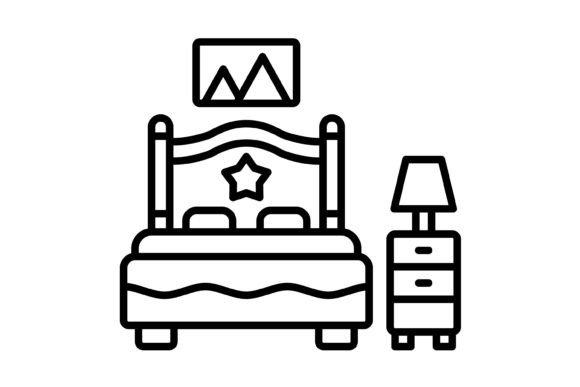
The digital landscape relies heavily on visual shorthand to communicate complex ideas instantly. In the realm of interior design, real estate, and personal lifestyle applications, the representation of a sleeping space requires more than just a photograph; it demands a universal symbol that transcends language barriers. The Bedroom Outline Icon serves as a fundamental component in this visual language. It is not merely a decorative element but a functional tool designed to guide user behavior, organize information, and maintain aesthetic consistency across various media. As applications and websites become more cluttered with information, the need for clean, minimalist vector assets has increased significantly. This specific icon set, featuring distinct line art, addresses the modern demand for clarity, ensuring that a user can identify a "bedroom" category or feature within milliseconds.
The Architecture of Line-Based Design
Understanding the design philosophy behind a high-quality Bedroom Outline Icon requires an appreciation for negative space and stroke weight. Unlike solid icons, outline icons rely on the interplay between the drawn line and the background color. This style of design is often preferred in modern User Interface (UI) trends because it feels lighter and less intrusive than heavy, filled shapes. The Bedroom Outline Icon set discussed here is crafted to maximize usability. Each line is designed with precision to ensure that when scaled down to the size of a mobile notification bar or scaled up for a presentation slide, the integrity of the image remains intact.
The use of vectors is the technical backbone of this design approach. A raster image, such as a standard JPG, loses quality when resized. However, the vector formats included in this package—specifically AI, EPS, and SVG—use mathematical equations to draw lines rather than pixels. This means a designer can take the Bedroom Outline Icon and apply it to a billboard or a business card with zero loss of fidelity. This scalability is essential for professional workflows where assets are often repurposed across different touchpoints, from a favicon on a browser tab to a large illustration on a landing page.
Technical Specifications and File Utility
A common challenge for designers and developers is receiving assets in a format that is incompatible with their specific software stack. A comprehensive icon package mitigates this issue by offering a variety of file types. The inclusion of AI and EPS files caters to vector-based software like Adobe Illustrator, allowing for deep customization of anchor points and stroke colors. This is particularly useful for branding purposes; a web developer might need to adjust the Bedroom Outline Icon to match a specific hex code defined in a client's style guide.
For web developers and mobile app creators, the SVG (Scalable Vector Graphics) format is often the most critical. SVGs are code-based, meaning they can be manipulated via CSS and JavaScript. This allows for dynamic interactions, such as changing the color of the Bedroom Outline Icon when a user hovers over it or animating the lines to draw themselves upon page load. Furthermore, the inclusion of PNG files with transparent backgrounds ensures that content creators using less advanced tools, such as word processors or basic slide deck software, can easily overlay the icon onto complex backgrounds without unsightly white boxes surrounding the image.
The versatility of the formats included—AI, EPS, JPG, PNG, and SVG—ensures that the Bedroom Outline Icon is not restricted to one type of user. Whether the asset is being integrated into a complex React application or printed on a physical architectural blueprint, the file format requirements are met.
Platform Agnosticism: From Mobile to Print
The modern creator does not work on a single screen. A project might begin on a desktop interface, move to a mobile review, and end up in a printed brochure. The Bedroom Outline Icon is designed to be platform-agnostic. In the context of mobile apps, where screen real estate is premium, the icon must be legible at very small sizes. The "clean lines" feature mentioned in the asset description is vital here; excessive detail would blur into obscurity on a small smartphone screen. Conversely, in a presentation setting, the icon acts as a visual anchor for text-heavy slides, helping to break up content and maintain audience engagement.
For print applications, such as interior design magazines or real estate flyers, the high-resolution vector capability ensures that the Bedroom Outline Icon prints with crisp edges, even on high-DPI commercial printers. This dual capability—digital and physical—makes the asset a practical investment for agencies that handle both web and print media.
Real-World Applications and Use Cases
The utility of a bedroom icon extends far beyond simple labeling. In the real estate industry, floor plans are essential tools for communicating the layout of a property. A standardized Bedroom Outline Icon allows agents to quickly annotate rooms, helping potential buyers visualize the flow of a home. When these icons are consistent in style across a listing, it conveys a sense of professionalism and attention to detail.
In the hospitality sector, hotels and booking platforms use icons to convey amenities. A clear Bedroom Outline Icon helps travelers quickly identify room types, such as suites with multiple sleeping areas or dormitory-style accommodations. The "outline" style is particularly effective here as it blends into minimalistic website designs often favored by boutique hotels and modern travel agencies.
For educators and researchers, these icons serve as visual aids. A presentation on sleep hygiene or architectural history can benefit from a clean visual representation of a bedroom without the distracting details of a photograph. The icon becomes a neutral vessel for information, focusing the viewer's attention on the data or the narrative being presented rather than the specific aesthetic of a photographed room.
Workflow Integration and Editing
One of the primary advantages of a well-structured icon pack is the ease of integration into existing design systems. The claim that the icons are "Easy to edit and scale" is a significant technical benefit. In a design workflow, consistency is key. If a team is using a Bedroom Outline Icon alongside icons for a kitchen, bathroom, and living room, they all need to share the same stroke weight, corner radius, and general style to look cohesive.
Because the source files (AI/EPS) are included, a designer can open the Bedroom Outline Icon and modify it to fit specific constraints. For example, if the design system dictates that all icons must have rounded caps rather than butt caps, the designer can make this change globally. If the icon needs to be simplified further for a "light" version of an app, unnecessary details can be removed. This level of control is impossible with flat image formats and is a requirement for professional-grade design work.
Accessibility and Semantic Meaning
When implementing icons in digital products, accessibility is a critical consideration. A Bedroom Outline Icon must be accompanied by proper alt text or ARIA labels so that screen readers can interpret the image for visually impaired users. The visual clarity of the icon helps users with cognitive disabilities or low literacy levels navigate an interface, but it must be paired with text equivalents to be truly inclusive.
The semantic meaning of the icon should be unambiguous. While stylization is important for branding, the core representation of a bed or a bedroom must be recognizable. The "outline" style helps here by stripping away textures and shadows that might obscure the silhouette. A user should not have to guess whether an icon represents a bedroom or a generic "rest" area; the design must communicate its intent immediately.
Trends in Iconography and Future-Proofing
Design trends evolve rapidly. In recent years, there has been a shift away from skeuomorphism (designs that mimic real-world textures) toward flat and semi-flat design. The Bedroom Outline Icon fits perfectly into the current "flat 2.0" or material design trends, which emphasize bold lines and simple geometric shapes. However, because the assets are vectors, they are future-proof. If the trend shifts toward thicker lines or animated icons, the vector source files can be adapted to meet these new standards without requiring a complete overhaul of the asset library.
The inclusion of 100 vector icons in this package suggests a comprehensive approach to the subject matter. A single Bedroom Outline Icon might not cover all scenarios. A robust set might include variations such as a child's bedroom, a master suite, a bedroom with a desk (for studio apartments), or a bedroom with specific furniture like nightstands or lamps. This variety allows creators to select the most specific visual representation for their context, reducing ambiguity for the end-user.
Conclusion of Technical and Practical Analysis
The Bedroom Outline Icon represents a convergence of art and utility. It is a tool that facilitates communication between a brand and its audience, or between a professional and a client. By offering a suite of file formats including AI, EPS, JPG, PNG, and SVG, the asset package acknowledges the diverse needs of the modern creative ecosystem. It empowers mobile developers to build responsive interfaces, allows print designers to produce high-quality collateral, and enables business owners to maintain a consistent visual identity.
The value of such an asset lies in its reliability. When a designer downloads the Bedroom Outline Icon, they are not just acquiring a picture of a bed; they are acquiring a scalable, editable, and versatile piece of design infrastructure. In a digital environment where attention spans are short and visual noise is high, the ability to communicate "bedroom" instantly, clearly, and beautifully is a distinct advantage. Whether used in a mobile app for smart home control, a website for an interior design portfolio, or a presentation on housing trends, the icon remains a steadfast element of effective visual communication.